Guides · Marco Island, Florida
Museums and Historic Sites in Marco Island
Two thousand years is a long time to hold a coastline. The Calusa did it; the Mackle brothers took a decade. Marco Island’s museums and markers are the awkward, honest record of both.
The Cat in the Room
The Marco Island Historical Museum at 180 S Heathwood Dr is the only place in the world you will see the Key Marco Cat outside the Smithsonian. The small carved wooden figure, recovered in Frank Hamilton Cushing’s 1896 expedition, is one of the finest pre-Columbian artworks found in North America. It sits on loan from the Smithsonian, which is a polite way of saying the island’s own past is a borrowed artifact.
The museum earns a 4.8 rating from 703 reviews. That is not a coincidence. People come for the cat and stay for the story of how a Calusa settlement became a dredge-and-fill subdivision. The building itself does not pretend to be old. It is a modern structure holding ancient things, which is the correct posture for a town that invented itself in the 1960s.
The Society Behind the Glass
Directly connected to the museum is the Marco Island Historical Society, sharing the same address and a 4.8 rating from 78 reviews. The society is the institutional memory that the museum displays. It runs the archives, the programming, the curation. If the museum is the face, the society is the filing cabinet.
The distinction matters here. Marco Island has no deep civic history to draw on; it was incorporated as a city on 28 August 1997, a fact that reads like a punchline to the Calusa’s five-century tenure. The society fills the gap by treating the recent past with the same seriousness as the ancient one. That is not irony. That is necessity.
The House That Time Forgot
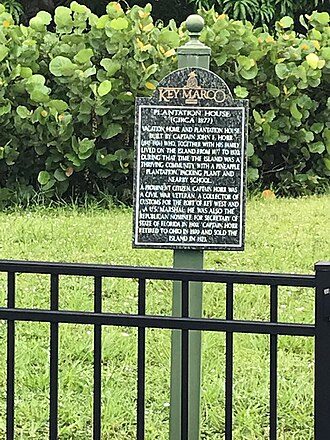
The Capt. John Foley Horr House is the awkward relative at this family reunion. Rated 2.5 from 27 reviews, it is the only surviving structure that predates the Mackle brothers’ bulldozers, or so the markers claim. The low rating is not a verdict on the architecture. It is a verdict on access. The house is not consistently open, and visitors who find it locked leave frustrated.
We have not been inside. We cannot tell you about the woodwork or the period furniture. What we can tell you is that a 2.5 rating in a town with a median age of 67.7 years means the retired population, people with time to visit, went and were disappointed. That is a specific kind of failure. A historical marker that you cannot read, a house you cannot enter, is just a pile of old materials.
Markers and Landmarks
The Marco Island Historical Marker #2u sits somewhere on the island with a 4.2 rating from 11 reviews. That is a decent score for a sign. It tells you something about the quality of the text and the placement. The Marco Island Historical Landmark on Inlet Dr is rated 2.7 from 7 reviews, which suggests either the view is better than the plaque or the plaque is not worth the walk.
The Marco Island Historical Landmark - Pineapple Plantation at 251 S Barfield Dr is rated 3.0 from 2 reviews. Two reviews is not a sample; it is a rumor. The pineapple plantation is a name that mocks the present. Pineapples do not grow in dredged sand, and the marker likely commemorates a failed agricultural attempt that the Mackles erased with their $7 million purchase.
The Shape of the Past
Here is what the numbers say about Marco Island’s relationship with its own history. The population is 15,998. The median age is 67.7. There are 18,436 housing units, of which 9,264 are seasonal or recreational. That means more than half the homes are empty most of the year. The vacancy rate is 10,003 units. This is a town that exists for people who are not there.
The median home value is $866,200. The median gross rent is $1,955. The unemployment rate is 4.2 percent. Nearly 48 percent of residents hold a bachelor’s degree or higher. These are affluent, educated, temporary people. They are not the Calusa, and they are not the Mackles. They are the third layer of the island, and they visit the museum to understand the first two.
The Key Marco Cat is the anchor. It is the one object that forces the town to remember that this sandbar was holy before it was valuable. The Horr House is the counterweight, a reminder that the recent past is still decaying. The markers are the connective tissue, uneven and often underwhelming.
Tigertail Beach, one of the island’s two public beach accesses with parking and amenities, is not a historical site. But it is worth noting that the beach is public. The rest of the island, built by the Deltona Corporation through the 1960s, is mostly private. The past, here, is also gated.
The museum works because it does not flinch. It shows the Calusa artifacts and the Mackle brothers’ story in the same rooms. The cat is not decoration; it is evidence. The development is not progress; it is a fact. Marco Island is a place where fifteen hundred years of indigenous presence were followed by one decade of dredge and fill, and the best the town can do is put it all in a glass case and hope you read the labels.
That is enough. Most places cannot even do that.
Every business named above is one we hold a listing for, and every date traces to a source on our sources page. We do not describe menus, interiors or service we have not verified. Details change — confirm before you travel.